
Communication is not all about the words.
The words do matter, of course. A vague idea, buried under hedges and weak structure, will lose a room. But the words are only the top layer. There are far more invisible layers underneath.
This is where strong speakers become more than articulate. They become legible – they use the invisible layers so you can understand what they mean, where they stand, and what they need from the room.
Why the same words can sound different
Every time you speak, people are reading more than your sentences. They’re reading how you organise the thought, how your voice moves, what your body is doing, how you relate to the room, and what your emotional signal seems to be.
Most of that reading is unconscious. People rarely think “I trusted that answer because the structure was clear and the tone was steady.” They just say: “She seemed across it.” or “He sounded defensive.”
That’s why two people can say almost the same sentence and create completely different effects. One sounds calm and credible. The other sounds rushed and unsure. The script is similar. The communication is not.
The 5 invisible layers of communication
Here are the five invisible layers of communication:
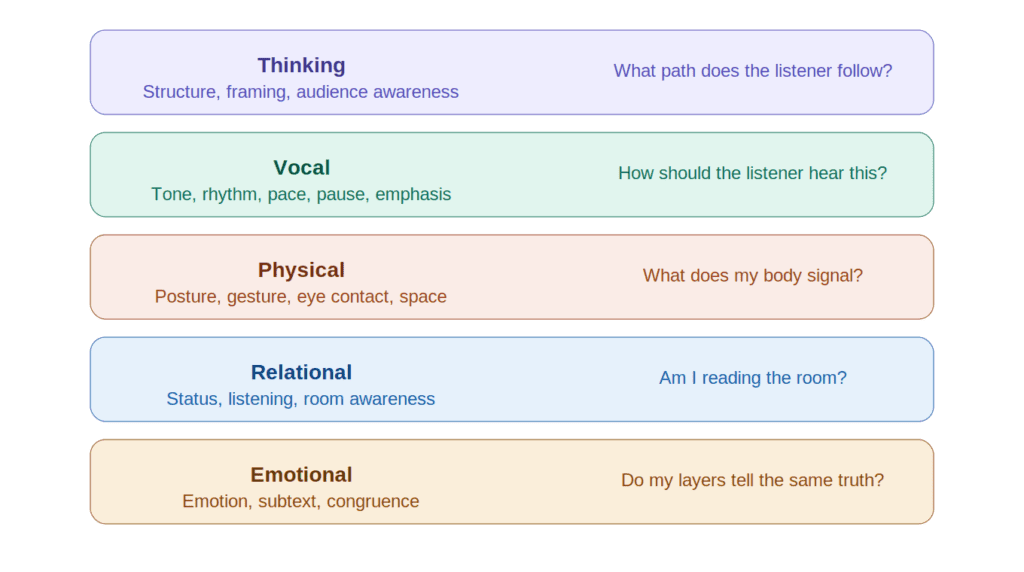
When these layers line up, communication feels clear. When they pull in different directions, even a strong idea becomes harder to trust.
1. Thinking — structure, framing, and audience awareness
The thinking layer is the path you give the listener.
It includes the order you put ideas in, the meaning you give them, and your sense of what this particular audience needs from you right now.
Many smart people get into trouble here. They have all the knowledge, so when someone asks a question, they start with the part that feels most technically accurate — which is often not what the listener needs first.
What listeners need first is orientation, that is, pointing them to what they need to know most. A useful three-part structure to do this is:
- Where are we? Name the situation clearly.
- What matters? Explain the risk, consequence, or decision.
- What should happen next? Give a concrete recommendation.
Instead of dumping every technical detail about why the project is late, you can try this:
“The migration is close, but the data is still unvalidated (1). Moving too quickly could corrupt customer records (2). My recommendation is one extra week to finish validation (3).”
That’s not dumbing anything down – it’s making the information more relevant and easier to take in.
2. Vocal — tone, rhythm, pace, pause, and emphasis
Your voice tells people how to hear the idea.
Under pressure, people often lose control of their voice before they lose control of their words. You may be trying to sound confident, but the room hears apologetic.
There are a number of tools you can use here:
- Tone is the emotional colour of your message.
- Rhythm is how your thinking moves through time.
- Pace is the speed you speak at.
- Pause is the space you leave between thoughts.
- Emphasis is where you place the importance.
These combine to give depth and texture to the words you say. Consider this example: “We may need another week before launch.”
- Said softly with a rising tone? This sounds like a confession
- Said quickly with no pause? This sounds like anxiety
- Said openly and steadily? This sounds like a responsible recommendation
A useful question to ask before any high-stakes communication: What does this moment need to feel like?
You can then use these vocal tools to give the room emotional instructions to follow.
3. Physical — posture, gesture, eye contact, space
Your body enters the conversation before your sentence does.
If your words say “this is manageable” but your face says “I am alarmed,” the room will believe your face first.
A grounded body changes the way you communicate. If you want to project confidence, you need your feet settled, breath available, and your spine alert without stiffness.
In a meeting, this means sitting upright, facing the people you’re speaking to, making eye contact, and letting your breath settle before you answer.
Space is part of the signal too. In person, it includes where you position yourself and whether you orient towards the people you are speaking to. Online, space shows up in your camera position, how much of your face is visible, and whether you look present or half-elsewhere.
Gestures can also help people follow the shape of an idea. If you’re explaining three options, marking them one by one with your hand gives the listener a physical structure to match the verbal one. Nervous gestures do the opposite – they leak energy without adding meaning.
These are not vanity concerns, they reduce friction. If people have to work harder to read you, they have less attention left for the idea.
4. Relational — status, listening, and room awareness
Communication is a live relationship with the room, not just a delivery.
Status (the invisible question of who seems to have authority in the moment) shows up in small behaviours.
A junior person can speak with strong status if they are clear, grounded, and useful. A senior person can lose it by rambling or seeming threatened by questions.
Compare these two responses to “Are we confident this will be ready by Friday?”
- Lower status: “I mean, I think so, but there are a few things and I’m not totally sure because the team is still checking…”
- Higher status: “Yes. The build is on track. The one open risk is data validation — we’ll know by Thursday whether that affects Friday.”
The second answer isn’t pretending everything is perfect. It holds the uncertainty cleanly.
Listening matters just as much as expression. A strong communicator can notice when the room is confused and slow down, or hear when people already have the point and stop adding detail.
These are signals you can adjust to. Phrases like “Let me make it clearer for you” or “The impact of this is…” let you regain ground with a drifting audience.
5. Emotional — emotion, subtext, and congruence
Emotion is always in the room. The skill is to let emotion inform the message without taking over.
If you’re worried about a risk, your concern can make the room pay attention. But if the worry floods your delivery, the room starts managing your anxiety instead of the actual decision.
The combination that creates focus is urgency and composure together.
Subtext is the message underneath the message. For example, “That’s fine” can mean genuine agreement, suppressed annoyance, or silent resignation — depending entirely on how it’s said.
In professional communication, subtext often carries the real issue:
- The real message may be: I need approval, but I don’t want to ask directly.
- The real message may be: I don’t believe this deadline is realistic.
Subtext becomes a problem when your words and signals don’t match. The room will almost always trust the subtext over the sentence.
That’s where congruence is important. When all your layers tell the same truth – words, voice, body, and emotional signal – communication becomes effortless to receive.
This is what people mean when they say someone has presence. The room can feel that the person speaking knows what they mean, understands who they’re speaking to, and can hold the moment without rushing, shrinking, or flooding it with detail.
A simple way to practise
Strong communication happens when all five layers point in the same direction. But you don’t need to work on all five layers at once.
Take one situation you regularly respond to at work, for instance: “The customer is asking for something we can’t safely build yet.”
- Thinking: Can you give the situation in one clear sentence, explain what matters, and offer a concrete recommendation?
- Vocal: Say it out loud. Slow it down. Put a pause before the recommendation.
- Physical: Let your breath settle first. Let your face match the seriousness of the point.
- Relational: Who’s in the room, and what decision are they trying to make?
- Emotional: Are you sounding apologetic when the message is actually a responsible recommendation?
In doing this, you’re not trying to become flawless. You’re trying to remove the interference that stops people hearing you clearly.
Final thoughts
If your ideas are strong but don’t always land, the issue is rarely the idea itself.
It’s usually one invisible layer — a tone that sounds uncertain, a rhythm too fast for the room, a subtext that says you’re asking permission to speak.
That’s good news, because these are all trainable, now you know what they are.